

Most keratin guides say the same two things: “don’t wash your hair too soon” and “use a sulfate-free shampoo,” as if every mistake carried the same weight and happened at the same moment. It doesn’t work that way: some mistakes only matter in the first 72 hours, others creep in week after week without you noticing, and there’s one that almost no one mentions — one that, in a beach town like Sitges, can make or break whether your smooth hair survives the summer.
The first 72 hours: the window that decides how long your keratin lasts
During the first three days after the keratine straightening, the hair fiber is still finishing the sealing process. Anything that seems harmless can leave a permanent crease or drastically shorten how long the result holds up.
| Situation | What to avoid | What to do instead |
|---|---|---|
| Washing your hair | Wetting or washing it before 72 hours | Wait the exact amount of time your stylist recommends for your specific formula |
| Updos | Ponytails, braids, headbands or clips | Wear it down and straight, even to sleep |
| Sleeping | Sleeping with wet or sweaty hair | Dry it thoroughly and avoid tucking it behind your ears |
At Raffel Pages Sitges we stress this point specifically during the appointment, because a crease set in those first hours can lock in and won’t disappear until the next wash, undoing hours of work done in the salon.
The everyday mistakes that shorten keratin week after week
Once the first 72 hours are behind you, the risk doesn’t disappear — it just changes shape. From here on, the most frequent mistakes come down to the products and habits you use every day.
The most common one is washing with a shampoo that contains sulfates or salt: these ingredients open the cuticle and strip away the keratin deposited with every wash, cutting the result down to weeks instead of months. Close behind is overusing a flat iron without heat protection, which dries out fiber that’s already been treated and can leave the ends brittle. And there’s a third, much less known mistake: using hair masks with too much protein, on the assumption that “more nourishing means better.” Your hair has already absorbed a heavy dose of protein during the treatment, and adding more can leave it stiff and less elastic than it was before you straightened it.
Our team always recommends alternating hydrating masks with ones specifically built for keratin maintenance, and saving pure-protein treatments for when your stylist specifically calls for them, not as a routine habit.
The mistake no one tells you about if you live near the sea
No generic keratin guide mentions this, and in a salon steps from the beach like ours, we see it every summer: salt water and chlorine are just as harsh on a straightening treatment as a sulfate shampoo — they just act all at once instead of wash by wash. A single swim in the sea without rinsing your hair afterward can do weeks’ worth of damage in a single afternoon.
At Raffel Pages Sitges, we recommend that clients who swim regularly at the beach or pool rinse their hair with fresh water immediately after swimming, even if they won’t shampoo it until later that night, and apply a lightweight serum with UV protection before direct sun exposure. Heavy summer sweat works in a similar way: it doesn’t break down the keratin all at once, but it forces more frequent washes, which is exactly what shortens its lifespan.
Why the initial diagnosis matters as much as aftercare
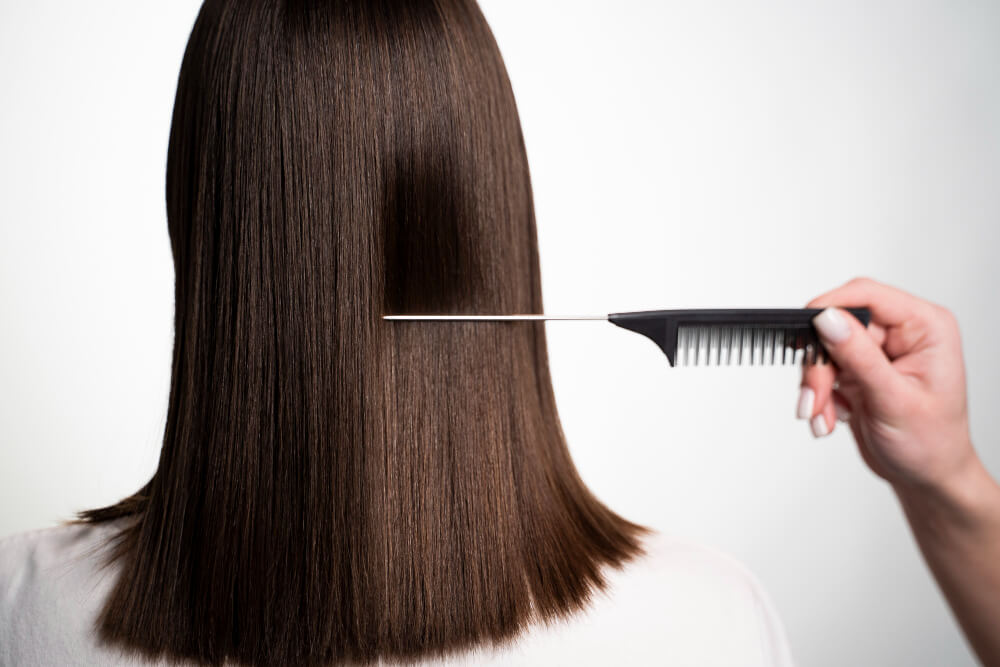
Many of the mistakes above never even come into play when the treatment was planned properly from the start. A proper diagnosis of your hair’s condition lets the stylist adjust the formula and heat exposure time depending on whether your hair is virgin, colored or has already been through bleaching, avoiding uneven results or premature fading that later gets wrongly blamed on aftercare at home.
In our salon we work with formaldehyde-free formulas and always assess porosity and color history before applying any keratin treatment, precisely so that aftercare has something solid to build on. There’s little point avoiding every mistake in this guide if the base treatment was never suited to your hair type in the first place.
Avoiding these mistakes doesn’t take a complicated routine — it takes knowing what to watch for and when, since the first 72 hours, the following weeks and a summer by the sea each pose different risks to the same result. If you’d like us to assess the condition of your hair before deciding whether keratin is right for you and how to maintain it, our salons in Sitges offer that diagnosis at every first visit, no strings attached.