

The question sounds simple, but the answer you find online is almost always the same: a generic table of weeks and hair types that ignores half of what actually matters. How often you should visit the salon does not depend solely on whether your hair is short or long — it depends on what you want to achieve and the real condition of your hair fibre right now. Maintaining a defined bob is not the same as growing out a highlighted mane, and living in a dry urban environment is not the same as living in a coastal town like Sitges.
At Raffel Pages Sitges we have been answering this question visit by visit for more than 25 years, and what we have learned is that the right interval is not calculated on a calendar — it is calculated on the hair. That said, there are clear patterns that work as a starting point, and there is one variable that almost no guide mentions and that, if you live or spend your summers by the sea, changes the rules entirely.
First: the difference between a trim and a cut — they are not the same thing
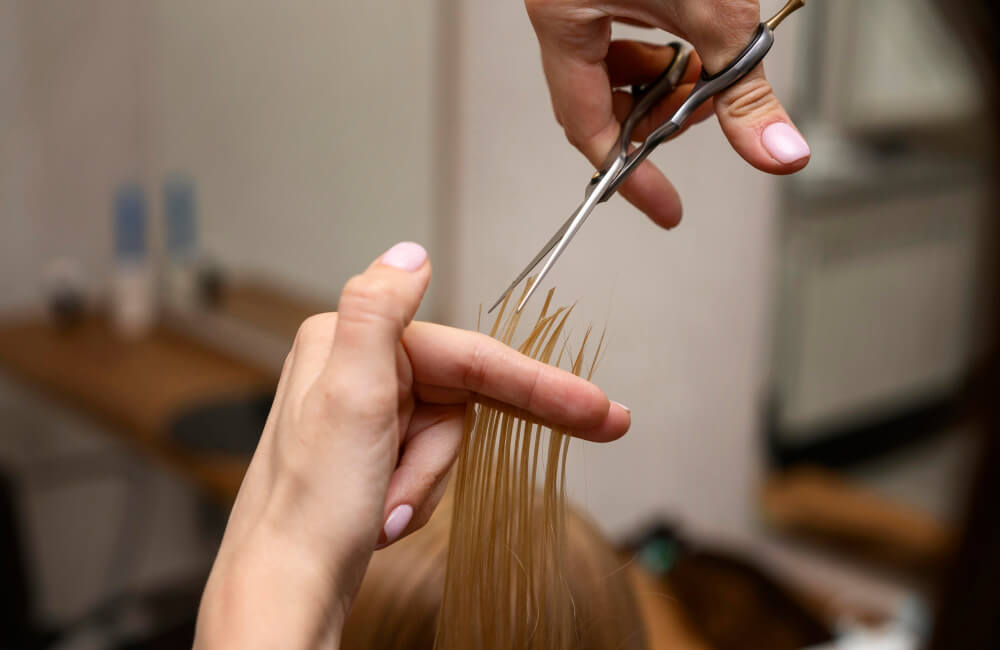
Before talking about frequencies, it is worth clarifying something that causes a great deal of confusion: cutting does not always mean changing your length or losing what you have gained. There are two very different procedures that are often bundled under the same name.
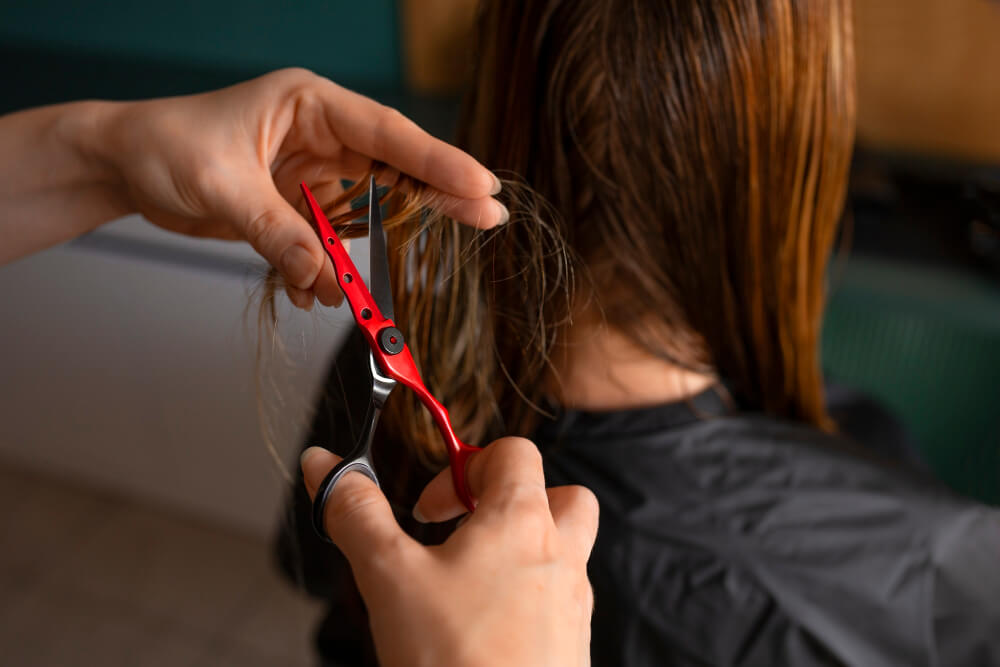
A trim removes between half a centimetre and one centimetre from the ends — just enough to eliminate the damaged portion without affecting the visible length. A maintenance cut involves reshaping the hair: how the layers fall, how the hair moves, how the outline is defined. Both are necessary, but at different moments and at different frequencies. One of the most common mistakes is avoiding a trim out of fear of losing length, only to end up at the salon months later needing to cut far more than would have been required had the problem been addressed sooner.
Short or highly structured hair: shape matters more than length
Short cuts — pixie, sharp bob, heavily layered cuts, blunt fringe — are the styles that suffer most with the passage of time, because their value lies precisely in the precision of the shape, and that precision starts to erode as soon as the hair grows a couple of centimetres in key areas. A pixie left untouched for ten weeks stops looking like itself. A bob that loses its back angle starts to look unkempt even if the hair itself is completely healthy.
The recommended frequency for this type of cut falls between 4 and 6 weeks, though it depends on individual growth speed — which varies considerably from person to person — and on how the hair is worn day to day. Those who use a hairdryer and straighteners regularly may find that the structure breaks down faster than those who wear their hair naturally.
Medium-length hair: where most people get the frequency wrong
Shoulder-length hair — from the jaw to the shoulders — is the length that causes the most confusion, because it holds up visually for quite a long time without a cut, but underneath it accumulates damage silently. The ends of medium-length hair are exposed to constant friction: against clothing, the neck, scarves. That friction opens the cuticle and generates split ends well before they are visible to the naked eye.
At Raffel Pages Sitges we recommend a trim every 6 to 8 weeks for clients with shoulder-length hair wearing it natural or with soft colour, and every 5 to 6 weeks for those with bleaching, heavy highlights or daily heat tools. Not because the cut needs reshaping that frequently, but because healthy ends are what allow the colour to keep looking luminous and the hair to have real movement.
Long hair: the great growth misunderstanding
The most persistent myth in women’s hairdressing is this: if I do not cut, I grow more. The reality is exactly the opposite in many cases. Hair does not grow faster or slower because the ends are trimmed — growth happens at the scalp, not at the tips — but damaged ends break off, and hair that breaks does not accumulate in length. The net result is that someone who goes months without a trim often has the same length as before, only with transparent, dry ends and the overall appearance of stagnant hair.
For long hair that needs to stay healthy while growing, the optimal trim frequency is every 10 to 12 weeks. Within that interval, only the deteriorated portion is removed — usually less than a centimetre — and the hair retains all the length gained. Wait longer and the damage travels up the shaft, increasing how much needs to come off.
Curly hair: frequency adapted to pattern and goal
Curly hair follows its own logic, which does not always align with that of straight hair. Curls have a naturally more open cuticle, making them more prone to dehydration, and their helical structure means split ends are harder to detect until the curl loses definition and starts to frizz excessively.
Here an important technical consideration comes into play: curly hair should almost never be cut wet, because the contracted curl can cause more length to be removed than intended. In our salon we work on curls dry or semi-dry, respecting their natural fall before deciding how much and where to cut. The recommended frequency varies according to the goal:
- To maintain the shape and volume of the curl: every 8 to 10 weeks.
- To grow it out without losing definition: every 12 weeks with minimal trims.
- For very tight curls or afro hair: every 10 to 12 weeks, with particular attention to moisture management between visits.
Coloured, highlighted or bleached hair: the condition of the ends directly affects the colour result
There is a direct relationship between the state of the ends and how the colour looks — something few guides explain clearly. When a balayage or babylight highlight ends in a porous, dry tip, that tip absorbs the tone unevenly and releases it faster than the rest of the hair. The result is a colour that looks dull weeks before it should, when the real problem is not the formula but the surface it has been applied to.
For this reason, at Raffel Pages Sitges we always coordinate colour appointments with cut appointments. This does not necessarily mean combining both services on the same day — it means not letting the ends deteriorate to the point where they start undermining the result of the investment made in colour. For highlighted or bleached hair, the recommended trim interval is every 6 to 8 weeks, regardless of length.
If you want to grow it out: the counterintuitive strategy that works
When someone decides to grow their hair out, the first thing they usually do is stop cutting it. Understandable — but exactly the opposite of what helps. Hair that grows without periodic trims accumulates damage at the ends that eventually forces more aggressive cuts to restore the fibre’s condition, losing months of growth in a single visit.
The most effective strategy for growing hair out while preserving its health is to combine very light trims — half a centimetre or less — every 12 to 16 weeks with an active moisturising routine at home. Salon visits are not eliminated: they are optimised. In the intervals between trims, treatments such as scalp botox or keratin masks help keep the fibre sealed and reduce breakage, limiting the accumulated damage.
The variable no guide mentions: living or summering by the sea

Running a salon steps from the beach has taught us something that generic guides on haircut frequency never address: a coastal environment accelerates end damage in a way that most people never connect directly to their appointment calendar.
Seawater deposits salt on the hair cuticle and opens it mechanically. Pool chlorine works in much the same way. Solar radiation in Sitges — particularly between June and September — progressively dries out the fibre. And the ambient humidity, which flattens fine hair and puffs up curly hair, forces more frequent washing that, in turn, accelerates wear on the ends.
In practice, this means that someone who trims perfectly well every 10 weeks in winter may need to do so every 7 or 8 during the summer months. Not because their hair grows faster — it does not — but because it deteriorates faster. Adjusting haircut frequency to the season is one of the most practical pieces of advice we give at Raffel Pages Sitges, and the one with the most visible impact on how the hair looks throughout the year.
The signals your own hair sends when it needs the scissors
Beyond any reference table, hair gives concrete signals that it is time to act. Recognising them early avoids having to cut more than necessary further down the line.
| Signal | What it indicates | Urgency |
|---|---|---|
| Transparent or very thin ends | Advanced structural damage to the fibre | High |
| Curl loses definition at the ends | Split ends are disrupting the curl pattern | High |
| Hair tangles far more than usual | The cuticle is open and rough | Medium-high |
| Colour looks dull despite being recent | Porous ends absorb and release pigment unevenly | Medium |
| The cut has lost its shape or fall | Growth has eroded the structure of the cut | Medium |
| Ends feel rough but are not visibly split | Early-stage damage — ideal moment for a preventive trim | Low-medium |
When several of these signals appear at once, it is not the moment to wait for the calendar to reach the usual appointment date — it is the moment to bring it forward. A timely trim almost always means preserving several centimetres of length that would otherwise be lost at the next visit.
Reference guide: frequencies by hair type and goal
| Hair type / situation | Goal: maintain shape | Goal: grow it out |
|---|---|---|
| Short or highly structured | Every 4–6 weeks | Every 6–8 weeks (minimal trim) |
| Shoulder-length, no treatment | Every 6–8 weeks | Every 10–12 weeks |
| Shoulder-length with colour or highlights | Every 5–7 weeks | Every 8–10 weeks |
| Long, no treatment | Every 10–12 weeks | Every 12–16 weeks |
| Long with bleaching or highlights | Every 6–8 weeks | Every 10–12 weeks |
| Curly (any length) | Every 8–10 weeks | Every 12 weeks |
| Beach environment or intense summer | Reduce the above intervals by 2–3 weeks | |
These frequencies are a starting point, not a universal prescription. Growth speed, heat tool use, the quality of products used at home and the previous state of the hair can all shift them in either direction. What does not change is the underlying principle: acting before the damage spreads always costs less — in time, in length and in money — than acting after.
If you are unsure how often your hair actually needs a salon visit, at Raffel Pages Sitges we carry out that assessment at the first appointment: we evaluate the real condition of the fibre, the treatment history and what you want to achieve, and give you a concrete plan for the months ahead.